
2026 Export Industry Observation: New Energy Vehicle Exports Are Growing Fast, and the Opportunity Goes Beyond Complete Vehicles
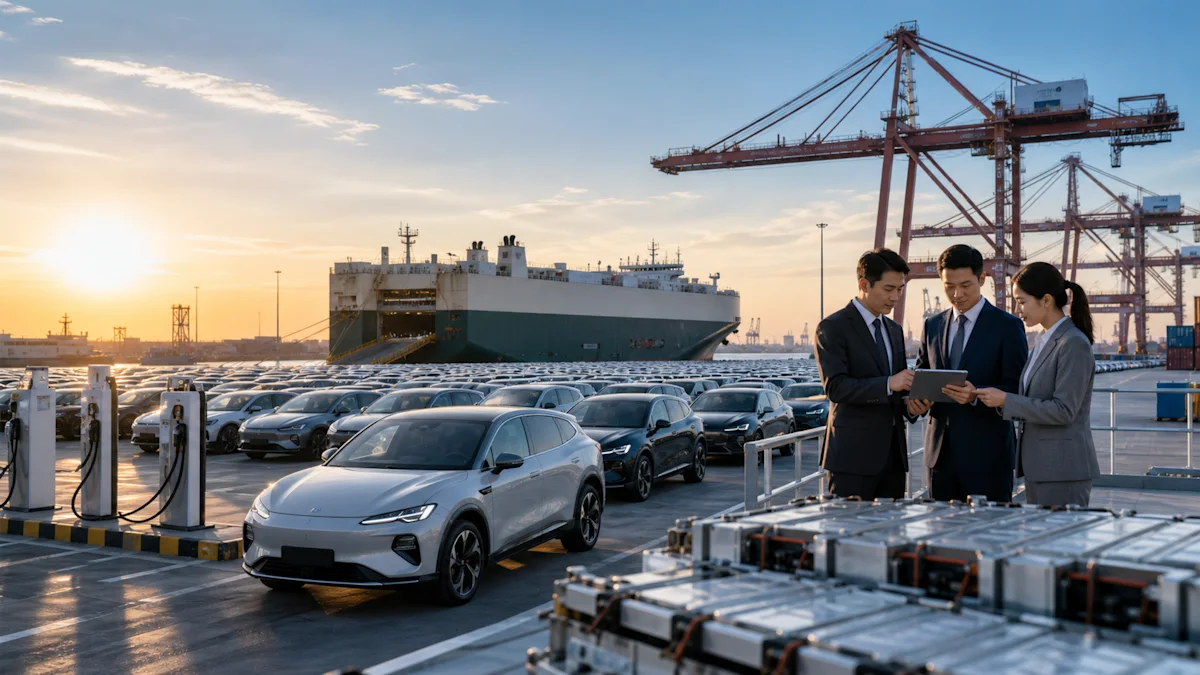
1. Which export sector deserves the most attention this year?
Based on data from the first four months of 2026, new energy vehicles and the broader green, low-carbon supply chain are among the most important export directions for Chinese companies this year.
According to data released by China's General Administration of Customs and reported by Chinese media, China's exports of mechanical and electrical products reached RMB 5.92 trillion in the first four months of 2026, up 17.6% year on year and accounting for 63.5% of total exports. Within that category, electric vehicle exports grew 68.1%, lithium battery exports grew 43.2%, wind turbine exports grew 40.7%, and industrial robot exports grew 30%. These figures show that this year's export growth is not limited to traditional labor-intensive products. The stronger theme is industrial upgrading, represented by new energy, advanced manufacturing, and smart equipment.
If we only look at growth rate, electric vehicles already stand out. If we look at industry pull-through, new energy vehicles are even more important. A vehicle exported overseas does not only involve the vehicle itself. It also involves batteries, motors, electric control systems, charging equipment, automotive electronics, smart cabins, repair parts, after-sales service, logistics, local channels, financing, and insurance.
This means the opportunity is not limited to complete vehicle brands. It also belongs to many small and mid-sized companies and specialized suppliers serving the overseas expansion of the new energy vehicle ecosystem.
2. Why are new energy vehicle exports still growing strongly this year?
The growth of new energy vehicle exports is not driven by a single factor. It comes from global demand, China's supply capability, and a maturing industrial chain.
1. Global markets are still looking for more cost-effective electrification solutions
The International Energy Agency noted in Global EV Outlook 2026 that global electric car sales exceeded 20 million units in 2025, up about 20% year on year. In emerging markets outside China, Europe, and the United States, electric car sales increased from about 1.3 million units in 2024 to around 2 million units in 2025, a rise of nearly 50%.
This is important for Chinese companies. In the past, many Chinese vehicle makers and parts suppliers treated Europe as a priority market. Now, more incremental demand is spreading to Southeast Asia, the Middle East, Latin America, and other markets. These markets need affordable vehicles, but they also need charging infrastructure, repair networks, spare parts supply, and localized operating support.
2. China's supply chain has a combined advantage in vehicles, batteries, parts, and engineering capability
A new energy vehicle is not a single product. It is a complex system. Chinese companies have built strong advantages in battery manufacturing, vehicle manufacturing, supply chain response, electronic and electrical architecture, cost control, and large-scale production.
When overseas customers buy China-related new energy vehicle products, they usually do not only compare unit prices. They also care about:
• Stable supply;
• Proven vehicle or component matching experience;
• Certification, installation, commissioning, and after-sales support;
• Adaptation to local climate, roads, charging conditions, and usage habits;
• The ability to help dealers, fleets, or project owners reduce operating costs.
This gives Chinese companies a chance to move from selling products to providing solutions.
3. Emerging markets need stronger landing capability
Many emerging markets do not lack purchasing interest. What they often lack is the operating foundation. Charging facilities may be insufficient, after-sales repair systems may be weak, spare parts turnover may be slow, financing solutions may be immature, and technician training may be inadequate. These gaps create new entry points for Chinese companies.
When a country starts to introduce new energy vehicles at scale, the first beneficiaries are not necessarily only vehicle makers. They also include:
• Charging pile and charging station construction companies;
• Battery testing, maintenance, and recycling companies;
• Auto parts and wear-part suppliers;
• Commercial vehicle, logistics vehicle, taxi, and ride-hailing fleet solution providers;
• Repair tool, diagnostic equipment, and technician training providers;
• Overseas warehouse, spare parts warehouse, and local channel service providers.
3. Where are the opportunities for Chinese companies?
The opportunities behind new energy vehicle export growth can be divided into six more specific directions.
Opportunity 1: Extending from complete vehicle exports to parts and spare parts
After complete vehicle exports grow, the aftermarket naturally expands. Once vehicles enter local markets, repair, maintenance, collision repair, and spare parts replacement create continuous demand.
Chinese companies can focus on categories such as:
• Battery pack structural components and thermal management parts;
• Motors, electric control systems, wiring harnesses, and connectors;
• Lights, bumpers, interior parts, and chassis components;
• Tires, braking systems, filters, and other consumables;
• Repair testing equipment and fault diagnosis tools.
This opportunity fits component companies with stable production, reliable quality, and fast response. Compared with building a complete vehicle brand, parts exports can serve a wider customer base, including dealers, repair chains, importers, fleet operators, and regional agents.
Opportunity 2: Charging infrastructure going overseas
As the installed base of new energy vehicles grows, charging infrastructure becomes a necessary gap to fill. In many overseas markets, public charging, industrial park charging, fleet charging, commercial parking lot charging, and solar-storage-charging solutions are all new demands.
Chinese companies can focus on:
• AC chargers and DC fast chargers;
• Charging station management systems;
• Integrated solar, storage, and charging solutions;
• Fleet charging dispatch systems;
• Installation, operation, maintenance, and remote monitoring services.
In the Middle East, Southeast Asia, and Latin America in particular, charging infrastructure is often linked to real estate, energy, urban transportation, logistics parks, and public projects. Customers may not be automotive companies. They may be energy companies, engineering contractors, bus operators, parking lot operators, or government project owners.
Opportunity 3: Commercial vehicles and fleet electrification
Passenger vehicle exports are affected by brand preference, channels, and consumer habits. Commercial vehicles and fleet scenarios are more focused on operating costs, vehicle reliability, and after-sales support.
Chinese companies can pay attention to:
• Electric logistics vehicles;
• Electric buses;
• Electric light trucks and heavy trucks;
• Vehicles for closed scenarios such as ports, mines, industrial parks, and airports;
• Taxi, ride-hailing, and rental fleet replacement.
These customers are more rational in procurement and have clearer decision logic. If a supplier can prove total cost of ownership, driving range, charging efficiency, maintenance convenience, and spare parts supply capability, it has a better chance of entering the shortlist.
Opportunity 4: Local channels and after-sales systems
New energy vehicle exports cannot rely only on one-time sales. What overseas customers truly worry about is after-sales service, warranty, spare parts, and response speed.
This creates new cooperation needs around local service capability:
• Regional dealer partnerships;
• Authorized local repair outlets;
• Technician training and certification;
• Spare parts warehouse setup;
• After-sales work order systems;
• Remote diagnosis and customer support.
For Chinese companies, those that help overseas partners build after-sales capability earlier are more likely to establish long-term cooperation.
Opportunity 5: Certification, compliance, and localization
Different countries have different requirements for vehicles, batteries, charging equipment, electrical safety, communication standards, road regulations, and after-sales warranty. As export volume grows, compliance capability becomes a key factor in whether a company can keep entering a market.
Chinese companies need to watch:
• Product certification and market access requirements;
• Charging interface and power grid adaptation;
• Battery transport, recycling, and safety standards;
• Data compliance and connected vehicle regulation;
• Warranty terms and after-sales responsibilities;
• Local taxes, tariffs, and trade policy changes.
This also means certification agencies, testing institutions, cross-border legal service providers, overseas warehouses, and local operating consultants may all find new service opportunities around new energy vehicle exports.
Opportunity 6: Moving from finding buyers to finding scenarios
Traditional foreign trade development often starts with products and buyer lists, such as finding importers, dealers, and wholesalers. The new energy vehicle supply chain is more suitable for a scenario-first approach.
For example:
• Is a logistics company replacing fuel vehicles?
• Does a taxi company have a vehicle renewal plan?
• Do ports or mines need low-emission transport equipment?
• Is an energy company building a charging network?
• Does a government have a public transportation electrification project?
• Does a dealer need Chinese brands or supporting spare parts?
Starting from scenarios makes it easier to judge whether a customer has real demand and to design the right product mix and sales message.
4. Which overseas customers are worth developing first?
Around new energy vehicle exports, Chinese companies can prioritize the following customer types:
1. Auto importers and regional dealers: Suitable for complete vehicle, parts, spare parts, and after-sales equipment companies.
2. Fleet operators: Including logistics, taxi, ride-hailing, rental, bus, and industrial park vehicle operators.
3. Charging infrastructure operators: Including energy companies, parking lots, real estate groups, commercial complexes, and urban transportation project owners.
4. Engineering contractors and system integrators: Suitable for charging stations, energy storage, solar power, park transportation, and public project cooperation.
5. Repair chains and spare parts distributors: Suitable for auto parts, diagnostic equipment, repair tools, and training services.
6. Government and public transportation related institutions: Suitable for buses, sanitation vehicles, port vehicles, and public charging projects.
These customers share one feature: their procurement is not a one-time inquiry. Their decisions are based on long-term operation, cost reduction, and service assurance. When developing these customers, Chinese companies should not only send product catalogs. They should provide market entry plans, cost calculations, case evidence, and after-sales commitments.
5. How should Chinese companies capture this window?
1. Select markets before selecting customers
Do not start with a global spray-and-pray approach. Based on the target product, companies should first select three to five priority markets and evaluate local new energy vehicle penetration, import policies, charging infrastructure, channel maturity, competing brands, and after-sales gaps.
For example, charging pile companies can prioritize markets with large charging infrastructure gaps. Spare parts companies can prioritize markets where Chinese brand vehicle ownership is growing quickly. Commercial vehicle companies can prioritize markets with clear electrification needs in logistics, public buses, and industrial park transport.
2. Use data to judge customer authenticity
There are many customer types in the new energy vehicle supply chain. A company name and email address are not enough. Companies need to combine websites, customs data, procurement records, social media activity, job postings, project news, bidding information, and local channel relationships to judge whether a customer is real, has budget, and has decision-making power.
Effective customers usually show several signals:
• A clear business scenario;
• Recent vehicle, equipment, or energy project activity;
• Import, distribution, engineering, or operating qualifications;
• Identifiable decision makers or procurement managers;
• Previous procurement or cooperation records in related categories;
• Public information that matches communication content.
3. Change sales emails from product introductions to scenario solutions
Overseas customers receive a large number of product promotion emails every day. If a new energy vehicle supply chain company only writes "good quality, competitive price, welcome inquiry," it is unlikely to receive many replies.
A more effective approach is to express value around the customer's scenario:
• For dealers: Emphasize model or spare parts margin, stable supply, and after-sales support.
• For fleets: Emphasize energy cost, maintenance cost, vehicle availability, and charging efficiency.
• For charging operators: Emphasize equipment compatibility, operation and maintenance systems, payback period, and remote monitoring.
• For repair chains: Emphasize spare parts coverage, technical training, diagnostic tools, and response speed.
• For government or public project owners: Emphasize safety standards, project experience, delivery cycles, and local service capability.
Customers do not lack suppliers. They lack partners who can explain the problem clearly, reduce risk, and show a practical landing path.
4. Build a long-term follow-up mechanism
The procurement cycle for new energy vehicle-related customers is often long. No order today does not mean no opportunity. Many customers go through research, testing, small-batch trials, local certification, channel trial sales, and then larger procurement.
Companies need a continuous follow-up mechanism to record the customer's market, vehicle needs, project stage, decision makers, sample status, certification progress, and next action. Only by accumulating the follow-up process can teams avoid wasting leads.
6. What can Xingzhi Huoketong help companies do?
In the overseas expansion of new energy vehicles and the related supply chain, the biggest challenge for many companies is not whether a market exists. It is how to find customers with real demand, budget, and decision-making power.
Xingzhi Huoketong helps foreign trade teams complete the key steps from customer discovery to follow-up management around target industries and target markets:
• Filter potential customers by country, industry, product, and application scenario;
• Identify importers, dealers, fleets, charging operators, repair chains, and other customer types;
• Help find key decision makers and contact information;
• Use public information for customer background checks and priority scoring;
• Generate outreach messages that better match customer scenarios;
• Manage follow-up rhythm and reduce lead drop-off.
For new energy vehicle, auto parts, lithium battery, charging pile, repair equipment, and overseas after-sales service companies, the next stage of foreign trade growth is not simply about finding more email addresses. It is about building a repeatable, filterable, and sustainable overseas customer development system.
Conclusion: This year's opportunity lies in the second-layer demand behind new energy vehicle exports
In the first four months of 2026, electric vehicle exports grew strongly, showing that China's new energy supply chain is still in an overseas expansion window. But for most Chinese companies, the opportunity worth capturing is not necessarily direct complete vehicle exports. It is the second-layer demand created by vehicle exports: charging, spare parts, repair, channels, fleet operations, certification, compliance, and localized services.
Companies that identify these scenarios earlier, find real customers, and build local partnerships are more likely to secure sustained orders in this round of new energy globalization.
Data Sources
• IEA Global EV Outlook 2026: Global electric vehicle market and emerging market growth trends


